Worldwide shipping available · 全球配送服務

Open post

Introducing Vesta Mix — A Practical Dilution Calculator for Frontline Cleaning and Infection Control

At NaDCC, we understand that infection control is not only about products — it is also about using them correctly.

That is why we developed Vesta Mix, a simple web-based dilution calculator designed specifically for frontline users such as janitors, cleaners, schools, clinics, elderly homes, property management teams, and facility operators.

Why We Built Vesta Mix

In many workplaces, disinfectant dilution is still performed manually using printed charts, rough estimations, or inconsistent practices.

For non-technical users, dilution calculations can sometimes feel confusing or intimidating. Mistakes may result in solutions that are either too weak to disinfect effectively, or unnecessarily strong and wasteful.

Vesta Mix was created to solve this problem.

Our goal was simple:

Create a practical, easy-to-use tool that helps everyday users prepare disinfectant solutions safely, accurately, and confidently.

Designed for Real-World Use

Unlike laboratory-focused calculators, Vesta Mix was designed with operational simplicity in mind.

The interface is intentionally clean and straightforward, allowing users to:

  • calculate dilution ratios quickly,
  • prepare different solution volumes,
  • reduce mixing errors,
  • and improve day-to-day infection control practices.

The tool is mobile-friendly and can be used directly on-site during cleaning operations.

Supporting Better Infection Control

Correct disinfectant preparation plays an important role in maintaining hygiene standards in:

  • schools,
  • clinics,
  • elderly care facilities,
  • offices,
  • public venues,
  • food preparation areas,
  • and commercial buildings.

By making dilution calculations easier and more accessible, Vesta Mix helps support safer and more consistent cleaning practices.

Free to Use

Vesta Mix is available free of charge as part of NaDCC’s ongoing effort to support practical infection control and public hygiene awareness.

We believe good tools should help real people solve real operational problems.

Try Vesta Mix today:

https://nadcc.hk/vesta-mix/

We welcome feedback and suggestions as we continue improving the platform.

Open post

Looking Beyond the Headlines: The WHO’s Latest Emergency and What It Means for Shared Community Hygiene

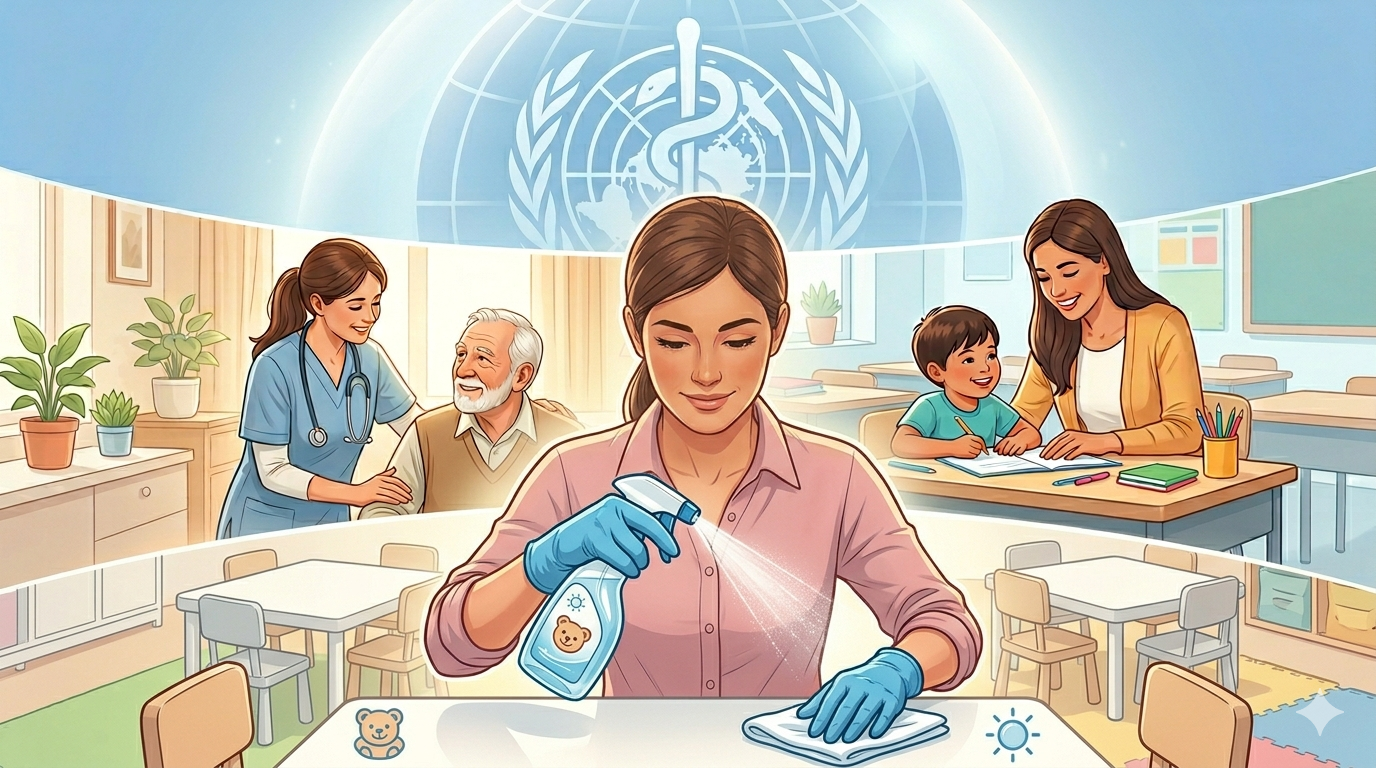
With the World Health Organization (WHO) declaring a new Public Health Emergency of International Concern (PHEIC), it is natural to look at the headlines and wonder what it means for our daily routines. In Hong Kong, whether we are managing a household, running a school, or operating caregiver environments like elderly homes and childcare centers, staying informed is simply part of how we look out for one another.

The latest declaration responds to an expansion of the Bundibugyo strain of Ebola in East and Central Africa. While local bodies like Hong Kong’s Centre for Health Protection (CHP) are taking proactive measures at our borders, they emphasize that the immediate risk to our local community remains very low.

Understanding the medical realities and transmission characteristics of this non-typical virus can bring peace of mind, helping us focus on practical, calm, and highly precise steps for keeping our shared spaces safe.

Confronting the Medical Reality: Why Prevention Comes First

International public health experts and organizations like Doctors Without Borders (MSF) have highlighted a major challenge in managing this outbreak: there are currently no approved vaccines or targeted antiviral cures anywhere in the world for the Bundibugyo strain. The highly effective vaccines that the public commonly associates with halting recent Ebola epidemics are strictly engineered for the Zaire strain and do not offer cross-protection against this virus.

In the absence of vaccines or specific cures, even a moderate clinical mortality rate poses a serious risk to highly specific, vulnerable environments. For young children with developing immune systems, or elderly residents in care homes who live with chronic health conditions, the introduction of such a high-risk pathogen into a shared facility would create an immense, unmanageable burden of care.

This means that with medical intervention (vaccines and targeted treatments) currently unavailable, Environmental Infection Prevention and Control (IPC) becomes our single most critical shield.

Understanding Transmission in Care and Group Environments

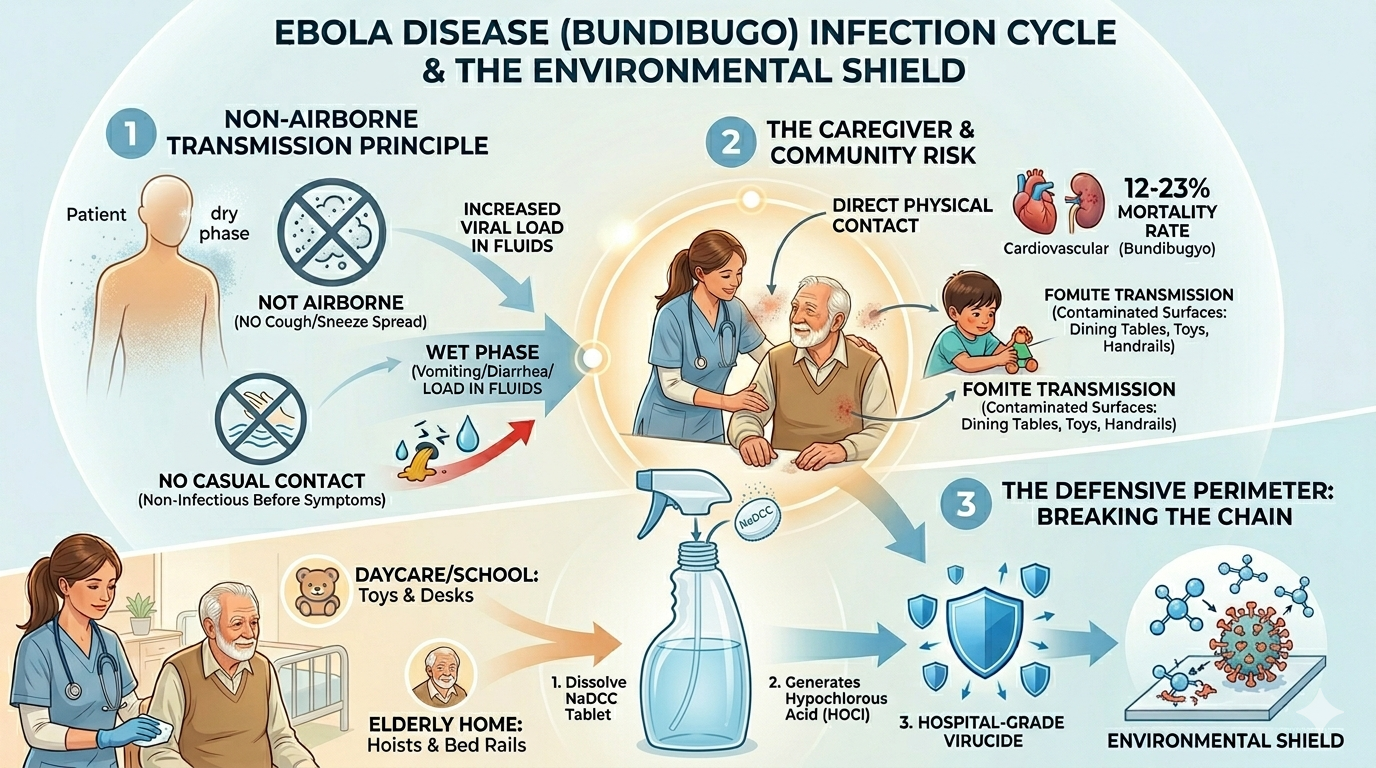
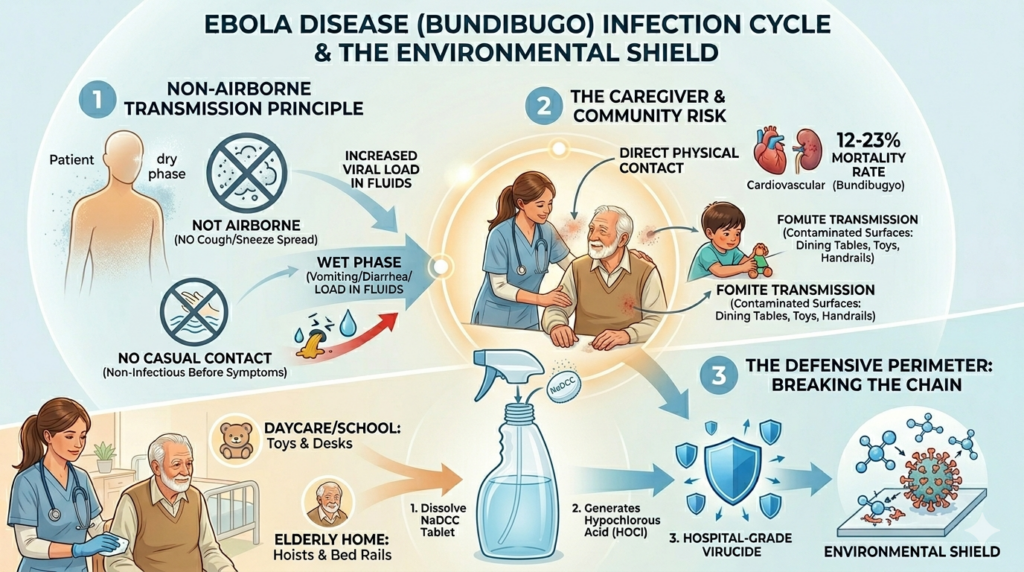
Fortunately, this virus is entirely non-airborne. It does not spread through the air, respiratory droplets, or casual everyday contact. Instead, its transmission relies strictly on direct contact with contaminated bodily fluids or physical surfaces that have been soiled by those fluids.

Because of this specific physical pathway, the thoroughness of environmental surface hygiene directly determines the safety of high-traffic or high-contact settings:

  • Elderly Homes & Caregiver Services: Residential care environments involve frequent physical assistance, bathing, and personal care routines. This means shared handrails, hoists, medical beds, and dining tables naturally become high-frequency touchpoints requiring robust defense.

  • Schools & Childcare Centers: Children naturally explore through physical touch and continuously share toys, desks, and play equipment, requiring highly efficient and reliable virus elimination mechanisms.

  • The Family Home: The ultimate sanctuary where all members return at the end of the day, making it the final line of defense against everyday germs brought in from the outside world.
 

Cleanliness Guidelines from Global Health Bodies: The Role of NaDCC

When international health organizations look at managing surface contamination for resilient viruses when vaccines are unavailable, they bypass temporary or cosmetic cleaning routines. They recommend compounds that thoroughly neutralize pathogens at a molecular level while remaining stable, predictable, and manageable for staff and families alike.

This is exactly why the World Health Organization (WHO) explicitly references and recommends NaDCC (Sodium Dichloroisocyanurate) in its global infection control and outbreak management guidelines.

In both public and domestic care settings, NaDCC provides irreplaceable protective value:

  • Releasing Hypochlorous Acid (HOCl): When a NaDCC tablet dissolves in regular water, it releases Hypochlorous Acid. This highly effective biocidal agent mirrors the human body’s natural defense system to eliminate 99.99% of bacteria, fungi, and both enveloped and non-enveloped viral structures.

  • Gentle Yet Powerful for Caregivers: Despite its medical-grade efficacy, the dissolved solution maintains a neutral, skin-friendly pH. It creates significantly less odor and irritation than traditional bleach, making it safe to use around classrooms, childcare centers, and elderly facilities without causing respiratory discomfort to sensitive groups.

  • High Stability in the Face of Uncertainty: Unlike traditional liquid bleach, which starts degrading and losing its potency within months of opening, NaDCC effervescent tablets stay perfectly stable in dry form for years. Care facilities and families can store a compact supply of tablets and instantly mix a fresh, full-strength solution exactly when needed—whether it’s a mild daily wipe-down for school desks or a high-level disinfection for a spill.

When medical vaccines and cures are still on the road to development, the most profound action we can take for our loved ones and caregiver colleagues is to align our environments with trusted international standards. By doing so, we turn everyday hygiene into an active act of care, creating a consistently clean, reassuring sanctuary for the people who matter most.

To explore our range of stable, easy-to-use NaDCC effervescent tablets and kits designed for complete peace of mind in homes, schools, and care facilities, visit the NaDCC Store.

S.F. Express Suspension of To-door Delivery Services

S.F. Express logo

Our logistic service provider, S.F. Express announced that their To-Door Delivery Services will be suspended starting from 5 March, 2022 (Saturday). In order to minimize delays, you are encouraged to use their network of SF Business Stations, SF Stores and SF Lockers. The original announcement can be found here.

– Please click here for the address and business hours of SF Business Stations.
– Please click here for the address and business hours of SF Stores.
– Please click here for the address and business hours of SF Lockers.

When placing an order, please fill in the Code for either the SF Business Station, SF Stores or SF Lockers as your shipping address.

Open post
Mid-Autumn Festival - NaDCC Fruit Wash

Oops! We just bought too many fruits for this Mid-Autumn!

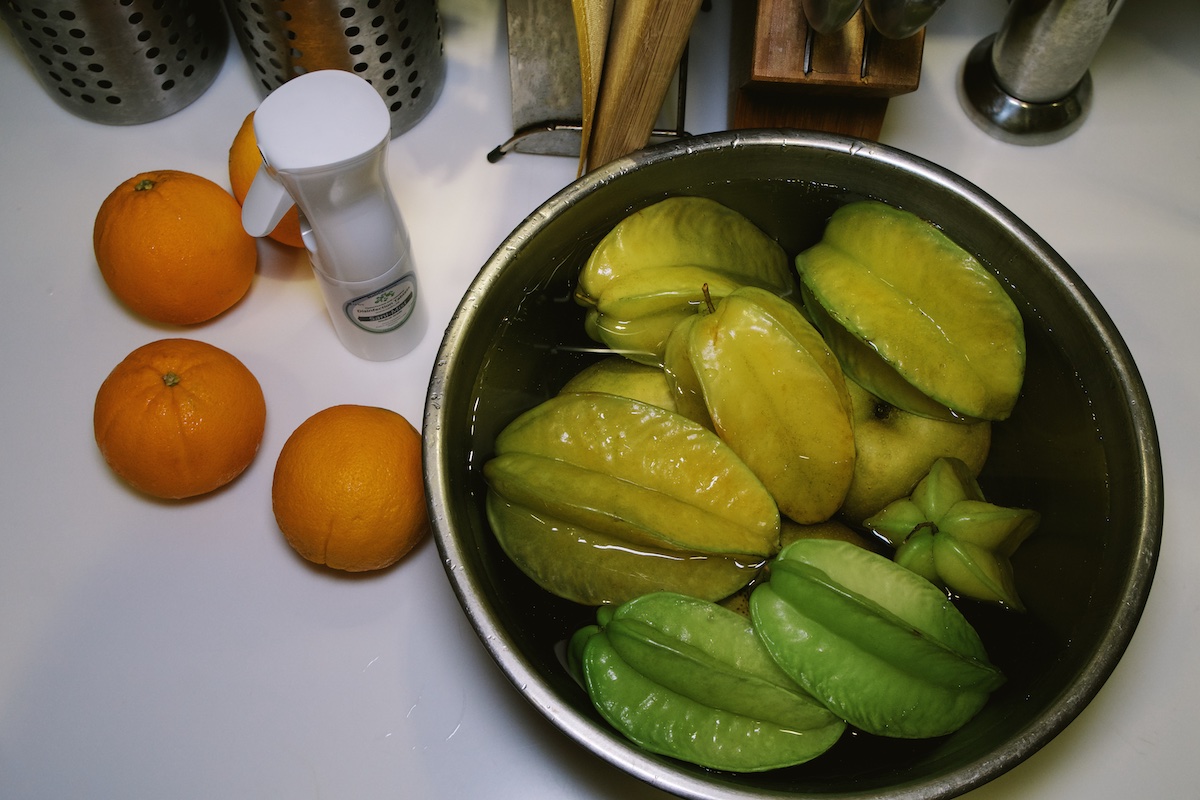
This is the first time my little 3-year old daughter learned about star fruit from school. She was so eager to try them out. My wife, my maid and I all bought some from the market. How could we finish the star fruits together with pears and other fruits before they all gone rotten?

Tips:

  • Prepare 100 ppm NaDCC solution (Dilute from the 1,000 ppm disinfection spray that we have)
  • Soak all the fruits in the NaDCC solution for 15 minutes
  • Take them out to dry
  • Pop them back to the fridge

This should keep them fresh for another week or so 🙂


HAPPY MID-AUTUMN FESTIVAL!!!

NaDCC Fruit Wash

Open post
food safety

How to effectively disinfect fresh fruits and vegetables?

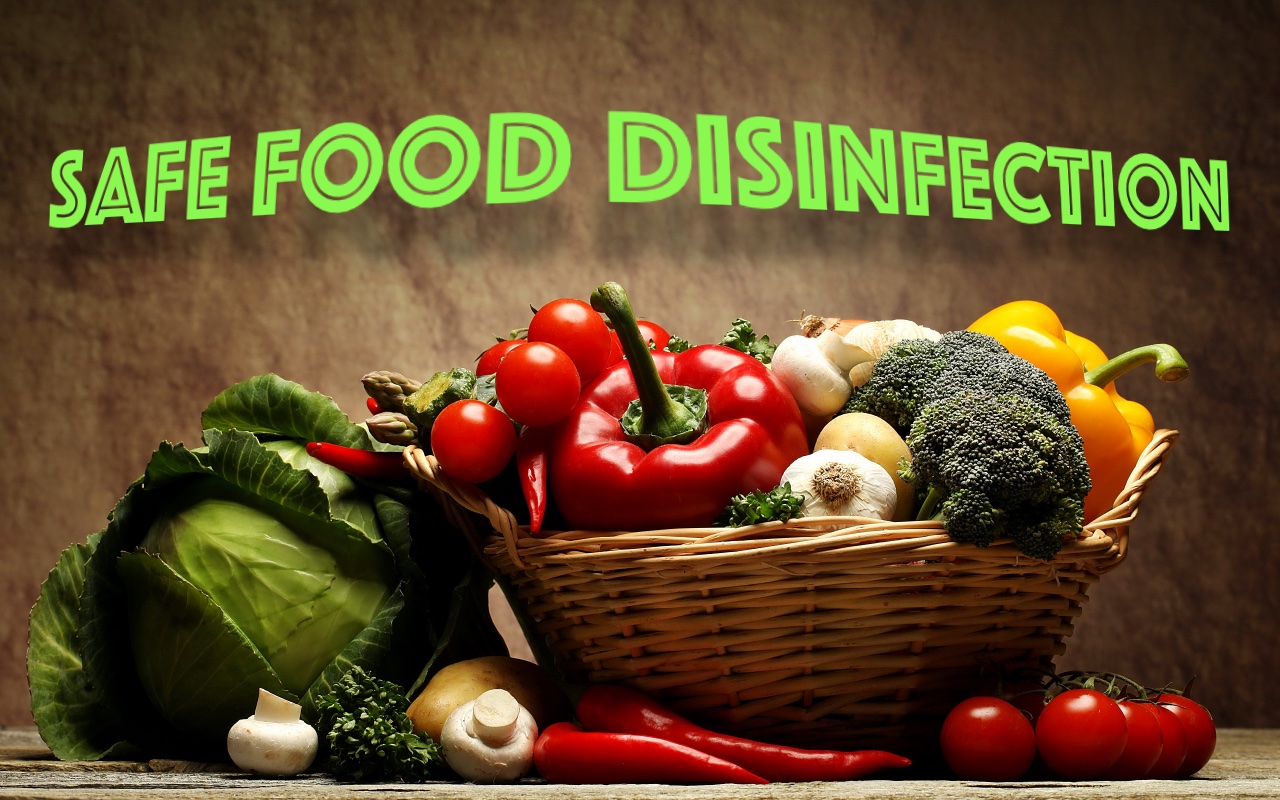
The catering industry also frequently uses sodium dichloroisocyanurate (NaDCC) tablets to comply with HACCP guidelines, which require all fresh fruits and vegetables to be thoroughly cleaned with a suitable disinfectant before preparation. NaDCC tablets are suitable for washing salads, vegetables and unpeeled fruits. NaDCC effectively kills bacteria targeted by the food industry such as E. coli, Salmonella, Listeria and Staphylococcus aureus. At the same time, NaDCC will not affect the taste and appearance of food. Continue reading

Open post
chlor-clean banner

全新包裝Chlor-Clean現已上市

對於大部份消毒劑,有機物和清潔劑都會構成損害,使其殺菌效能大幅降低。所以,市面很難找到高效能的消毒清潔劑。二氯異氰尿酸鈉(NaDCC)這廣譜消毒成份本身就不會受有機物影響。英國Guest Medical把獨有負離子表面活性劑(anionic surfactant)的清潔劑和二氯異氰尿酸鈉(NaDCC)混合製成了方便好用的Chlor-Clean消毒清潔劑,該清潔劑能夠有效去除污垢油跡,同時不會降低二氯異氰尿酸鈉(NaDCC)的消毒效能。由於清潔劑的分解油脂能力,使Chlor-Clean更有效快速破壞包膜病毒(enveloped virus)的脂肪包膜,從而提高消毒殺菌的效能。新型冠狀病毒(COVID-19)、流感病毒、乙型肝炎病毒均屬於這類包膜病毒(enveloped virus)。 Continue reading

Open post
BruTab 6S vs Bleach

Introduction to BruTab 6S NaDCC Disinfectant Tablets

BruTab 6S is a hospital-grade disinfectant approved by the US EPA. The benefit lies in its potency to prevent hospital acquired or nosocomial infection (HAI), including COVID-19. All germs will be killed within minutes. It also meets the requirements for disinfection in food industry. NaDCC is gentle to most surfaces and skin. It doesn’t damage surfaces, and it does not irritate human skin. It is often used by veterinary clinics, too. And it won’t discolour clothes like bleach. NaDCC sterilized tablets can be stored for a long time, and the physical size is small, which is convenient for storage. It can be used without rinsing and continue to effectively kill virus for up to 24 hours. The smell is light, not pungent like bleach.

Watch video below.

簡介BruTab 6S NaDCC消毒錠

BruTab 6S是美國EPA認可醫院級的消毒劑。好處在於強效,以防止醫院感染(HAI)的細菌,包括新冠肺炎,都能在指定的幾分鐘內殺滅。同時亦符合食物生產場所消毒要求。對於大部份表面和皮膚都比較溫和,不損物件表面,不刺激皮膚。獸醫診所都經常使用。而且 不會像漂白水般令衣物褪色。NaDCC消毒錠可儲存時間長,而且體積細小,方便存放。塗抹後不用過水,持續有效殺毒長達24小時。氣味比較清淡,沒有漂白水般刺鼻。


https://youtu.be/OlZdCw7rmhE
Scroll to top